Plantifact
Plantifact
Plantifact

Plantifact is a gamified habit-tracking app that encourages users to adopt sustainable behaviors by growing a personalized virtual garden. Logging real-world eco-actions like recycling, saving water, or using public transit, unlocks plants, biomes, and decorative elements.
Plantifact is a gamified habit-tracking app that encourages users to adopt sustainable behaviors by growing a personalized virtual garden. Logging real-world eco-actions like recycling, saving water, or using public transit, unlocks plants, biomes, and decorative elements.
Plantifact is a gamified habit-tracking app that encourages users to adopt sustainable behaviors by growing a personalized virtual garden. Logging real-world eco-actions like recycling, saving water, or using public transit, unlocks plants, biomes, and decorative elements.
Team Members
Team Members
Team Members
Team of 4
Team of 4
Duration
Duration
Duration
5 Weeks
5 Weeks
Technologies
Technologies
Technologies
Figma
FigJam
Adobe Photoshop
Microsoft Word
Figma
FigJam
Adobe Photoshop
Microsoft Word
Problem Statement
Problem Statement
Problem Statement
Many eco-conscious people want to live more sustainably, but daily actions like recycling, saving water, or using public transit feel small, invisible and easy to skip. Existing trackers are dull, provide little feedback and don’t translate real-world effort into immediate, motivating progress. so good intentions fade and habits don’t stick.
Many eco-conscious people want to live more sustainably, but daily actions like recycling, saving water, or using public transit feel small, invisible and easy to skip. Existing trackers are dull, provide little feedback and don’t translate real-world effort into immediate, motivating progress. so good intentions fade and habits don’t stick.
Many eco-conscious people want to live more sustainably, but daily actions like recycling, saving water, or using public transit feel small, invisible and easy to skip. Existing trackers are dull, provide little feedback and don’t translate real-world effort into immediate, motivating progress. so good intentions fade and habits don’t stick.
Project Purpose
Project Purpose
Project Purpose
This project was created to demonstrate a strong behavioral design approach through gamification. By transforming sustainable actions into a visually rewarding and emotionally meaningful experience, Plantifact uses habit loops, ownership, achievement systems, and unlockable content to promote lasting behavior change in eco-curious users.
This project was created to demonstrate a strong behavioral design approach through gamification. By transforming sustainable actions into a visually rewarding and emotionally meaningful experience, Plantifact uses habit loops, ownership, achievement systems, and unlockable content to promote lasting behavior change in eco-curious users.
This project was created to demonstrate a strong behavioral design approach through gamification. By transforming sustainable actions into a visually rewarding and emotionally meaningful experience, Plantifact uses habit loops, ownership, achievement systems, and unlockable content to promote lasting behavior change in eco-curious users.
Solution We Aim
Solution We Aim
Our goal is to turn everyday eco-actions like recycling, saving water, taking transit into simple, rewarding habits. Users log real actions in seconds and those logs unlock plants, biomes, and decor, making progress visible and motivating so sustainable behavior sticks.
Our goal is to turn everyday eco-actions like recycling, saving water, taking transit into simple, rewarding habits. Users log real actions in seconds and those logs unlock plants, biomes, and decor, making progress visible and motivating so sustainable behavior sticks.
Solution We Aim
Our goal is to turn everyday eco-actions like recycling, saving water, taking transit into simple, rewarding habits. Users log real actions in seconds and those logs unlock plants, biomes, and decor, making progress visible and motivating so sustainable behavior sticks.
Target Users
Target Users
Target Users
Who?
Who?
Who?
Eco-curious users aged 16 - 35.
Eco-curious users aged 16 - 35.
Eco-curious users aged 16 - 35.
Motivations
Motivations
Self-growth
Habit Tracking
Visual Progress
Self-growth
Habit Tracking
Visual Progress
Behavioral Barrier
Behavioral Barrier
Difficulty staying consistent with sustainable actions.
Motivations
Self-growth
Habit Tracking
Visual Progress
Behavioral Design Framework
Behavioral Design Framework
Behavioral Design Framework
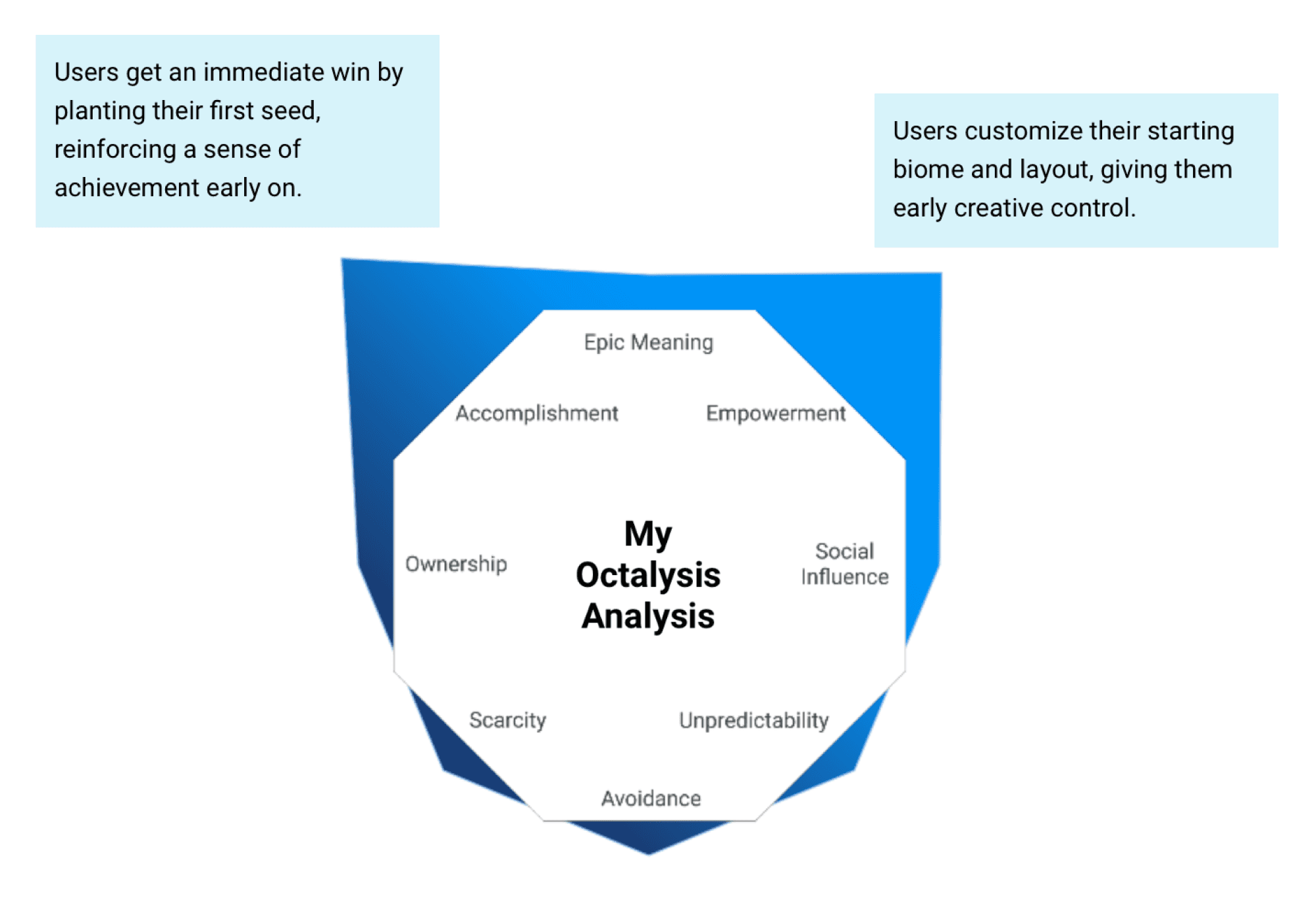
We applied the Octalysis Level 2 framework to guide user motivation across four key stages: Discovery, Onboarding, Scaffolding, and Endgame.
We applied the Octalysis Level 2 framework to guide user motivation across four key stages: Discovery, Onboarding, Scaffolding, and Endgame.
We applied the Octalysis Level 2 framework to guide user motivation across four key stages: Discovery, Onboarding, Scaffolding, and Endgame.
Onboarding
Onboarding
Onboarding
Users experience a quick win by planting their first seed right away. They then customize their starting biome like a forest or coral reef establishing early creative ownership.
Users experience a quick win by planting their first seed right away. They then customize their starting biome like a forest or coral reef establishing early creative ownership.
Users experience a quick win by planting their first seed right away. They then customize their starting biome like a forest or coral reef establishing early creative ownership.

Discovery
Discovery
Discovery
We spark users' curiosity by teasing unlockable rare biomes and plants, inviting exploration. They can also browse friends' gardens for inspiration, adding a light layer of social influence.
We spark users' curiosity by teasing unlockable rare biomes and plants, inviting exploration. They can also browse friends' gardens for inspiration, adding a light layer of social influence.
We spark users' curiosity by teasing unlockable rare biomes and plants, inviting exploration. They can also browse friends' gardens for inspiration, adding a light layer of social influence.

Scaffolding
Each eco-action helps the garden grow, reinforcing consistency. Seasonal plants and limited-time unlocks add excitement, while inactivity gently pauses growth to encourage re-engagement.

Endgame
Over time, users grow a unique eco-sanctuary: a visual record of their sustainable efforts. They can also compare gardens with others, fostering shared growth and community impact.
Scaffolding
Scaffolding
Each eco-action helps the garden grow, reinforcing consistency. Seasonal plants and limited-time unlocks add excitement, while inactivity gently pauses growth to encourage re-engagement.
Each eco-action helps the garden grow, reinforcing consistency. Seasonal plants and limited-time unlocks add excitement, while inactivity gently pauses growth to encourage re-engagement.
Endgame
Endgame
Over time, users grow a unique eco-sanctuary: a visual record of their sustainable efforts. They can also compare gardens with others, fostering shared growth and community impact.
Over time, users grow a unique eco-sanctuary: a visual record of their sustainable efforts. They can also compare gardens with others, fostering shared growth and community impact.
Ideation
Ideation
Ideation
We began with rapid ideation focused on translating sustainable habits into engaging digital interactions. Without user research, we relied on behavioral design principles and the Octalysis framework to guide concept development. Key ideas included visual progress, habit reinforcement through streaks, and garden-based rewards to make eco-actions feel personal and motivating.
We began with rapid ideation focused on translating sustainable habits into engaging digital interactions. Without user research, we relied on behavioral design principles and the Octalysis framework to guide concept development. Key ideas included visual progress, habit reinforcement through streaks, and garden-based rewards to make eco-actions feel personal and motivating.
We began with rapid ideation focused on translating sustainable habits into engaging digital interactions. Without user research, we relied on behavioral design principles and the Octalysis framework to guide concept development. Key ideas included visual progress, habit reinforcement through streaks, and garden-based rewards to make eco-actions feel personal and motivating.
Brainstorming Features
Brainstorming Features
Brainstorming Features
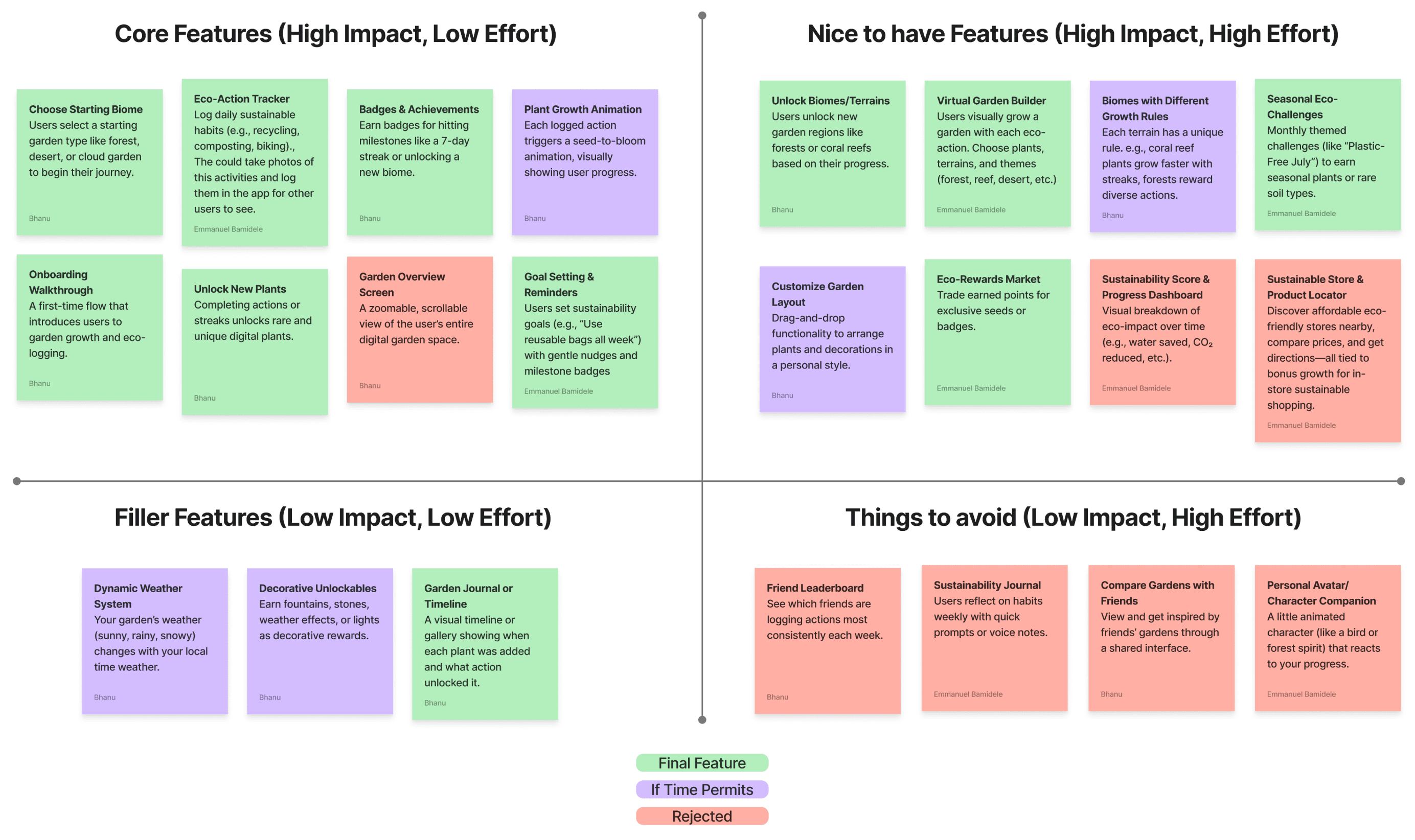
We generated a wide range of ideas to boost habit-tracking and engagement, then organized them on a 2x2 matrix to prioritize based on impact and feasibility.
We generated a wide range of ideas to boost habit-tracking and engagement, then organized them on a 2x2 matrix to prioritize based on impact and feasibility.
We generated a wide range of ideas to boost habit-tracking and engagement, then organized them on a 2x2 matrix to prioritize based on impact and feasibility.

Features Categorization
Features Categorization
Features Categorization
After mapping the features, we categorized them into four groups to guide our design scope: core features that were essential and high-impact, nice-to-have features that offered value but required more effort, filler features with minimal impact, and features to avoid that were high-effort with low return.
After mapping the features, we categorized them into four groups to guide our design scope: core features that were essential and high-impact, nice-to-have features that offered value but required more effort, filler features with minimal impact, and features to avoid that were high-effort with low return.
After mapping the features, we categorized them into four groups to guide our design scope: core features that were essential and high-impact, nice-to-have features that offered value but required more effort, filler features with minimal impact, and features to avoid that were high-effort with low return.
User Flows
User Flows
User Flows
Based on our prioritized features, we created user flows to map out key interactions such as onboarding, logging eco-actions, viewing achievements, and customizing the garden. This helped us structure the app’s core experience and ensure smooth, goal-oriented navigation.
Based on our prioritized features, we created user flows to map out key interactions such as onboarding, logging eco-actions, viewing achievements, and customizing the garden. This helped us structure the app’s core experience and ensure smooth, goal-oriented navigation.
Based on our prioritized features, we created user flows to map out key interactions such as onboarding, logging eco-actions, viewing achievements, and customizing the garden. This helped us structure the app’s core experience and ensure smooth, goal-oriented navigation.

Sketching
Sketching
Sketching
With the user flows in place, we moved into quick sketching to explore layout ideas and screen-level interactions. These low-fidelity sketches allowed us to rapidly visualize concepts, iterate on structure, and identify the most intuitive ways to present gamified elements like streaks, milestones, and garden customization.
With the user flows in place, we moved into quick sketching to explore layout ideas and screen-level interactions. These low-fidelity sketches allowed us to rapidly visualize concepts, iterate on structure, and identify the most intuitive ways to present gamified elements like streaks, milestones, and garden customization.
With the user flows in place, we moved into quick sketching to explore layout ideas and screen-level interactions. These low-fidelity sketches allowed us to rapidly visualize concepts, iterate on structure, and identify the most intuitive ways to present gamified elements like streaks, milestones, and garden customization.

Lo-Fi Design & Testing
Lo-Fi Design & Testing
Lo-Fi Design & Testing
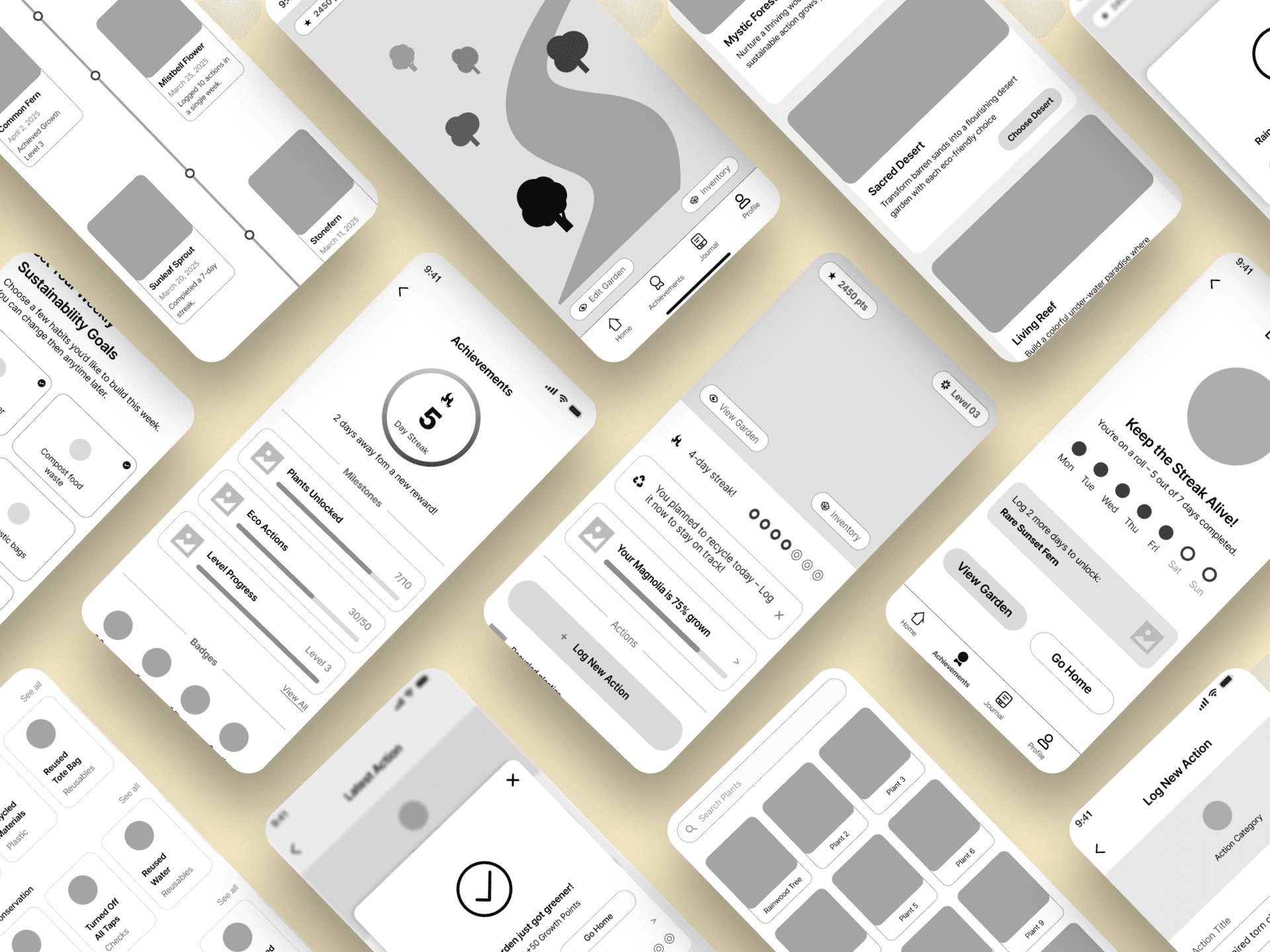
Building on our sketches, we created low-fidelity wireframes to define the app’s structure and core interactions. These designs focused on layout, flow, and functionality without visual styling, to validate how users would navigate key features like action logging, garden editing, and achievement tracking.
Building on our sketches, we created low-fidelity wireframes to define the app’s structure and core interactions. These designs focused on layout, flow, and functionality without visual styling, to validate how users would navigate key features like action logging, garden editing, and achievement tracking.
Building on our sketches, we created low-fidelity wireframes to define the app’s structure and core interactions. These designs focused on layout, flow, and functionality without visual styling, to validate how users would navigate key features like action logging, garden editing, and achievement tracking.
Lo-Fi Design Usability Testing
Lo-Fi Design Usability Testing
Lo-Fi Design Usability Testing
We conducted usability testing on the low-fidelity prototype to evaluate task flow, clarity, and overall usability.
We conducted usability testing on the low-fidelity prototype to evaluate task flow, clarity, and overall usability.
We conducted usability testing on the low-fidelity prototype to evaluate task flow, clarity, and overall usability.
Key Tasks Tested
Key Tasks Tested
Key Tasks Tested
Complete onboarding and log in / sign-up process.
Log a new eco-action.
View streak and achievements.
Edit garden layout.
Store and retrieve plants from inventory.
Complete onboarding and log in / sign-up process.
Log a new eco-action.
View streak and achievements.
Edit garden layout.
Store and retrieve plants from inventory.
Complete onboarding and log in / sign-up process.
Log a new eco-action.
View streak and achievements.
Edit garden layout.
Store and retrieve plants from inventory.
No. of Users Tested: 5
No. of Users Tested: 5
Issues Identified
Issues Identified
Garden Editing Confusion – Users weren’t sure when plant movement was finalized due to Figma limitations
Limited Feedback – Some users didn’t notice confirmation after storing items
New Concept – Since the growing garden concept was new to most users, it took them a little time to understand the overall purpose of the product.
Garden Editing Confusion – Users weren’t sure when plant movement was finalized due to Figma limitations
Limited Feedback – Some users didn’t notice confirmation after storing items
New Concept – Since the growing garden concept was new to most users, it took them a little time to understand the overall purpose of the product.
Positive Insights
Positive Insights
All the screens were well designed and laid out.
Users appreciated the streak tracking and instant reward feedback
Inventory and journal were clear and intuitive.
Overall navigation was smooth with minor improvements suggested
All the screens were well designed and laid out.
Users appreciated the streak tracking and instant reward feedback
Inventory and journal were clear and intuitive.
Overall navigation was smooth with minor improvements suggested
No. of Users Tested: 5
Issues Identified
Garden Editing Confusion – Users weren’t sure when plant movement was finalized due to Figma limitations
Limited Feedback – Some users didn’t notice confirmation after storing items
New Concept – Since the growing garden concept was new to most users, it took them a little time to understand the overall purpose of the product.
Positive Insights
All the screens were well designed and laid out.
Users appreciated the streak tracking and instant reward feedback
Inventory and journal were clear and intuitive.
Overall navigation was smooth with minor improvements suggested
Style Guide
Style Guide
Style Guide

Hi-Fi Design Overview
Hi-Fi Design Overview
Hi-Fi Design Overview
The high-fidelity design uses gamification and visual feedback to make sustainable actions engaging and rewarding. It reflects core behavioral principles from the Octalysis framework, turning eco-habits into a motivating and personalized experience.
The high-fidelity design uses gamification and visual feedback to make sustainable actions engaging and rewarding. It reflects core behavioral principles from the Octalysis framework, turning eco-habits into a motivating and personalized experience.
The high-fidelity design uses gamification and visual feedback to make sustainable actions engaging and rewarding. It reflects core behavioral principles from the Octalysis framework, turning eco-habits into a motivating and personalized experience.

Design Evaluation
Design Evaluation
Design Evaluation
We tested the high-fidelity prototype with 9 users to assess usability, clarity, and engagement. In addition to task-based testing, we conducted accessibility checks including text contrast, visual clarity, and color blindness simulations to ensure the interface was inclusive and easy to navigate for all users.
We tested the high-fidelity prototype with 9 users to assess usability, clarity, and engagement. In addition to task-based testing, we conducted accessibility checks including text contrast, visual clarity, and color blindness simulations to ensure the interface was inclusive and easy to navigate for all users.
We tested the high-fidelity prototype with 9 users to assess usability, clarity, and engagement. In addition to task-based testing, we conducted accessibility checks including text contrast, visual clarity, and color blindness simulations to ensure the interface was inclusive and easy to navigate for all users.
Contrast Checking
Contrast Checking
Contrast Checking
We tested key text and background color combinations for contrast, achieving WCAG AA and AAA compliance across normal and color-blind vision modes. All tested pairs exceeded the minimum contrast ratio requirements, ensuring readability and accessibility throughout the interface.
We tested key text and background color combinations for contrast, achieving WCAG AA and AAA compliance across normal and color-blind vision modes. All tested pairs exceeded the minimum contrast ratio requirements, ensuring readability and accessibility throughout the interface.
We tested key text and background color combinations for contrast, achieving WCAG AA and AAA compliance across normal and color-blind vision modes. All tested pairs exceeded the minimum contrast ratio requirements, ensuring readability and accessibility throughout the interface.

Color Blindness Simulation
Color Blindness Simulation
Color Blindness Simulation
We tested the UI under various color blindness conditions including Protanopia, Deuteranopia, and Tritanopia. The interface remained clear and distinguishable in most simulations. However, in the last two cases Achromatomaly (partial color blindness) and Achromatopsia (complete color blindness), some visual distinctions were reduced. Despite this, all critical functions and text remained legible, ensuring overall usability.
We tested the UI under various color blindness conditions including Protanopia, Deuteranopia, and Tritanopia. The interface remained clear and distinguishable in most simulations. However, in the last two cases Achromatomaly (partial color blindness) and Achromatopsia (complete color blindness), some visual distinctions were reduced. Despite this, all critical functions and text remained legible, ensuring overall usability.
We tested the UI under various color blindness conditions including Protanopia, Deuteranopia, and Tritanopia. The interface remained clear and distinguishable in most simulations. However, in the last two cases Achromatomaly (partial color blindness) and Achromatopsia (complete color blindness), some visual distinctions were reduced. Despite this, all critical functions and text remained legible, ensuring overall usability.

High-Fidelity Usability Testing
High-Fidelity Usability Testing
High-Fidelity Usability Testing
We tested the prototype with 9 users to assess usability and engagement. Tasks like action logging and garden editing were completed successfully. A pre-post study showed increased motivation, and feedback helped improve navigation and visual clarity.
We tested the prototype with 9 users to assess usability and engagement. Tasks like action logging and garden editing were completed successfully. A pre-post study showed increased motivation, and feedback helped improve navigation and visual clarity.
We tested the prototype with 9 users to assess usability and engagement. Tasks like action logging and garden editing were completed successfully. A pre-post study showed increased motivation, and feedback helped improve navigation and visual clarity.
Key Tasks Tested
Key Tasks Tested
Key Tasks Tested
Complete onboarding and log in / sign-up process.
Log a new eco-action.
View streak and achievements.
Edit garden layout.
Store and retrieve plants from inventory.
Complete onboarding and log in / sign-up process.
Log a new eco-action.
View streak and achievements.
Edit garden layout.
Store and retrieve plants from inventory.
Complete onboarding and log in / sign-up process.
Log a new eco-action.
View streak and achievements.
Edit garden layout.
Store and retrieve plants from inventory.
No. of Users Tested: 9
No. of Users Tested: 9
No. of Users Tested: 9

Usability Scores (SEQ) – Task Level Insights
Usability Scores (SEQ) – Task Level Insights
Usability Scores (SEQ) – Task Level Insights
We collected SEQ (Single Ease Question) scores from 9 participants after each task to evaluate perceived task difficulty on a 7-point scale.
Highest scores were seen for Tasks 8, 9, and 10, suggesting those screens felt intuitive and smooth to complete.
Lower scores for Tasks 3, 4, and 5 indicated some areas of confusion, particularly around logging custom actions and editing the garden.
Overall, most tasks scored above 6, reflecting strong usability with minor areas for refinement.
This evaluation helped us identify which interactions to polish further for better clarity and efficiency.
We collected SEQ (Single Ease Question) scores from 9 participants after each task to evaluate perceived task difficulty on a 7-point scale.
Highest scores were seen for Tasks 8, 9, and 10, suggesting those screens felt intuitive and smooth to complete.
Lower scores for Tasks 3, 4, and 5 indicated some areas of confusion, particularly around logging custom actions and editing the garden.
Overall, most tasks scored above 6, reflecting strong usability with minor areas for refinement.
This evaluation helped us identify which interactions to polish further for better clarity and efficiency.

Task Completion Time (sec)
Task Completion Time (sec)
Task Completion Time (sec)
We tracked how long users took to complete each task to evaluate interaction flow and efficiency.
Task 1 (onboarding + login) had the longest average time (38s), which is expected due to multiple steps involved.
Tasks 3 and 5 also took more time, likely due to action logging and plant editing requiring user input and interaction.
Tasks 7, 8, and 9 were completed quickly, indicating smooth navigation and clear UI cues.
We tracked how long users took to complete each task to evaluate interaction flow and efficiency.
Task 1 (onboarding + login) had the longest average time (38s), which is expected due to multiple steps involved.
Tasks 3 and 5 also took more time, likely due to action logging and plant editing requiring user input and interaction.
Tasks 7, 8, and 9 were completed quickly, indicating smooth navigation and clear UI cues.
We tracked how long users took to complete each task to evaluate interaction flow and efficiency.
Task 1 (onboarding + login) had the longest average time (38s), which is expected due to multiple steps involved.
Tasks 3 and 5 also took more time, likely due to action logging and plant editing requiring user input and interaction.
Tasks 7, 8, and 9 were completed quickly, indicating smooth navigation and clear UI cues.
Pre-Post Study
Pre-Post Study
Pre-Post Study
To evaluate changes in sustainability awareness and motivation, we conducted a pre-post study alongside our high-fidelity usability testing.
Users showed noticeable improvement across all areas, including tracking familiarity, confidence, and habit motivation.
Self-reported difficulty scores decreased, especially in remembering to log actions and finding new eco-friendly behaviors.
Action intent also improved, with most users planning to log daily and reflect on their impact more regularly.
These results suggest that Plantifact’s gamified experience meaningfully enhances both motivation and awareness around sustainable living.
To evaluate changes in sustainability awareness and motivation, we conducted a pre-post study alongside our high-fidelity usability testing.
Users showed noticeable improvement across all areas, including tracking familiarity, confidence, and habit motivation.
Self-reported difficulty scores decreased, especially in remembering to log actions and finding new eco-friendly behaviors.
Action intent also improved, with most users planning to log daily and reflect on their impact more regularly.
These results suggest that Plantifact’s gamified experience meaningfully enhances both motivation and awareness around sustainable living.
To evaluate changes in sustainability awareness and motivation, we conducted a pre-post study alongside our high-fidelity usability testing.
Users showed noticeable improvement across all areas, including tracking familiarity, confidence, and habit motivation.
Self-reported difficulty scores decreased, especially in remembering to log actions and finding new eco-friendly behaviors.
Action intent also improved, with most users planning to log daily and reflect on their impact more regularly.
These results suggest that Plantifact’s gamified experience meaningfully enhances both motivation and awareness around sustainable living.

User Feedback & Suggestions
User Feedback & Suggestions
User Feedback & Suggestions
“I love how the garden grows with my actions. It’s a fun way to stay motivated.”
– User 2
“I love how the garden grows with my actions. It’s a fun way to stay motivated.”
– User 2
“The onboarding was smooth, but I wish the action categories had more examples.”
– User 5
“The onboarding was smooth, but I wish the action categories had more examples.”
– User 5
“Seeing my progress visually made me reflect more on my habits.”
– User 3
“Seeing my progress visually made me reflect more on my habits.”
– User 3
“It would be great if I could set reminders to log my actions daily.”
– User 8
“The achievements screen was super encouraging, it made me want to keep going!”
– User 7
“It would be great if I could set reminders to log my actions daily.”
– User 8
“The achievements screen was super encouraging, it made me want to keep going!”
– User 7
High-Fidelity Screens
High-Fidelity Screens
High-Fidelity Screens
dfwg

dfwg
dfwg
Design Mockups
Design Mockups
dfwg
dfwg

d
© SuryaRithvik | UI/UX Designer | Product Designer
© SuryaRithvik | UI/UX Designer | Product Designer
© SuryaRithvik | UI/UX Designer | Product Designer